How to look after and feed your wormery
by Mark Ridsdill Smith on

in Blog, FAQs

(Including a downloadable worm menu – with gourmet treats!)

It’s easy once you know how

Wormeries are easy to run once you get the knack – you just need a bit of practise and info to get you on the right track. I must confess to killing two whole colonies (traumatic days!) before I went to the library to get a book on how to do it. Here’s the essential, ‘need to know’ facts to avoid the common pitfalls.

As long as you’re starting with a well designed wormery (an easy DIY one, here), there’s really only three things you need to do to keep it healthy: site it in a sheltered space, keep it moist, and most importantly, feed it carefully.

1. Feeding

Feeding is where things can most easily go wrong when you’re starting out.  Here’s the four golden rules

  1. Little at first: When starting your wormery, your first job is to feed it carefully and patiently while the worm population multiplies. You’ll probably have 300 – 500 worms in your wormery starter pack. But a mature, fully productive wormery has several thousand! Your worm population will double in size every two to three months, so it may take 12 – 18 months until your wormery is at full capacity. It’s better to add too little food than too much (particularly early on). Add too much and the food will putrefy (go off and get smelly). In optimal conditions, worms can eat about half their body weight a day. In cooler weather it will be a lot less.
  2. Add 20 – 30% carbon rich, ‘brown matter’ - that’s cardboard, newspaper or wood chips - in addition to the food waste. Cardboard and wood chip will also help create air spaces in the wormery (worms, like us, need air).
  3. Don’t add any one ingredient in large quantities (particularly processed foods).
  4. Feed it a varied diet. This will help create a healthy wormery and a rich worm compost full of nutrients and trace elements – good things include banana skins and comfrey leaves (for potassium), coffee and nettles (for nitrogen).
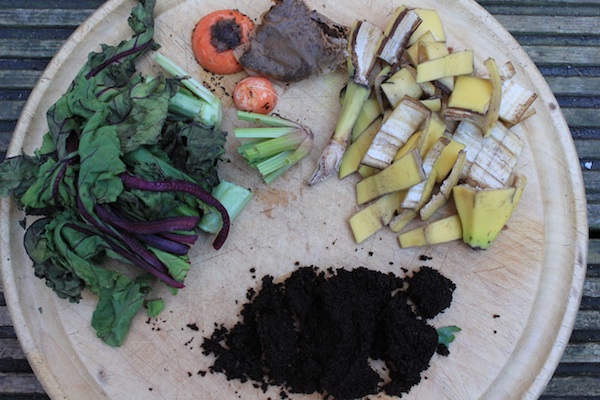
Examples of staple foods for a wormery: veg pelings, tea bags, coffee grounds and banana skins. Remember to mix in 20 - 30% card or wood chip as well

Examples of staple foods for a wormery: veg pelings, tea bags, coffee grounds and banana skins. Remember to mix in 20 – 30% card or wood chip as well

How do you know when to feed?

When you lift the lid of your wormery, can you see a few worms scouting round the surface? If yes, it needs feeding. If not, wait until you do. Usually you’ll find they need feeding once or twice a week.
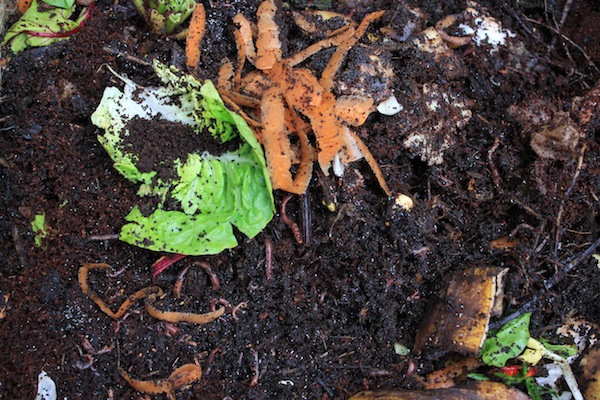
In this image you can see a few worms on the surface - this is usually a sign that they are hungry and need feeding.

In this image you can see a few worms on the surface – this is usually a sign that they are hungry and need feeding.

Worm Menu (including gourmet delicacies)

Yes to:            Mix about 20-30% carbon rich (brown font) with 70 – 80% nitrogen rich (black). Gourmet delicacies        Add when you find  –  none are essential. OK (in moderation) to: Wise to avoid completely until your wormery is established. No to:
Fruit peelings (worms love banana skins – a good source of potassium) Composted manure (add a 1 or 2 inch layer every 6 weeks) – adds valuable soil life. Worms love it! Onion skins (too acidic) Meat and Fish – these will be broken down in a wormery but may spread disease eg BSE.
Veg peelings eg potatoes, carrot, (not onions) Garden soil (just a handful here and there) – adds grit for worm gizzards and soil life. Citrus (too acidic) Dog / cat pooh
Cardboard – tear up in small pieces, and sprinkle with water to dampen it. Nettles – chop up and add a layer occasionally – rich in nitrogen and trace elements. Oily food
Newspaper / waste paper – shredded. Comfrey leaves – chop up and a layer occasionally – rich in potassium and trace elements. Spicy foods
Wood chip – composted if possible. (Avoid fresh pine wood chip) Liquid seaweed fertiliser – adds trace elements and promotes soil life. Effective but expensive and far from essential. Anything very salty (eg fresh sea weed)
Coffee grounds and tea bags. Fine sawdust
Leftover cooked foods (avoid adding in large quantities) Grass cuttings
Bread, rice, cereals, pastries, cake Garden waste
Egg shells – crushed Processed food
Green waste compost Cheese
Cut flowers

You can also download this menu as a pdf, here:

Holiday feeding

Worms are quite happy for two to three weeks without feeding. Don’t add excess food before you go away, as this may become rancid. Feed them as normal, perhaps adding extra damp cardboard and / or a layer of green waste compost or manure (this will provide food for the worms but won’t go off).

2. A sheltered site

Worms do best in a constant temperature, not too hot or too cold. A shady is spot is best (15 – 25 oC is optimum). If possible, it’s also good to place it somewhere protected from strong winds (to avoid it getting too cold) and rain (to minimise risk of flooding, see tip below).

Tip: If your wormery will be rained on, leave the worm juice tap (if there is one) open with a collection jug underneath. This will help prevent flooding and possible mass worm extinction.

 3. Keep the wormery damp

A healthy worm bin should be damp (like a squeezed out flannel) not dry or wet. Water lightly if it gets too dry. Add more paper and card if too wet.

Trouble shooting

The wormery should smell sweet and healthy. An unpleasant smell is a sign that something is wrong. The two most common causes of a bad smell are:

1. Overfeeding leading to putrefaction of uneaten food. Solution: feed less.

2. Adding too much green matter and too little brown matter. Solution: add more torn up card or newspaper or wood chippings.


That’s it! Do you have any other wormery tips or stories to share?

Related Posts Plugin for WordPress, Blogger...

{ 31 comments… read them below or add one }

Andrew Sutton October 12, 2012 at 2:38 pm

I can second the comment about leaving the tap open if the wormery can get rained on. I destroyed my first colony by leaving it out in the rain unchecked for just week and found it submerged in water. I’m two weeks into my second colony and things seem to going OK so far ..

Reply

Mark RS October 12, 2012 at 2:43 pm

I’m pleased it’s not just me that’s done that. Thanks for sharing, Andrew, and good luck with second colony.

Reply

Jools October 12, 2012 at 3:31 pm

Hi, I have a wormery that has been going well for a couple of years now and get lots of lovely worm juice from it. Never done anything to it – do I need to turn the composting matter? How do I do it (stupid question?) and how do I look after the worms when turning?

It smells sweet, not fed it for a while but dont see worms around the top. Do I just dive in to see if they are still alive?

Cheers

Reply

Mark RS October 12, 2012 at 3:39 pm

Hi Jools, no need to turn it – but, if you haven’t emptied it before, it sounds like you should have lots of lovely worm compost to use. It’s a fabulous fertiliser, even better (IMHO) than the worm juice. How to harvest it depends on the wormery. Some have trays which make it supper easy (just empty the lowest tray). If its in one big container, then you’ll probably need to empty the whole thing – keep about the top half (the most recent stuff added) on one side to return the wormery and ‘harvest’ the bottom half to use. This will probably contain some worms – you can either pick them out and put them back in (time consuming) or add them to your pots where they’ll usually continue to live – and they’ll do lots of good in your pots. Does this answer your question?

Reply

Jools October 12, 2012 at 3:55 pm

That’s fab! I have not emptied it as yet (its a commercial unit from original organics) but will do so soon. The worms seem content but since I have not seen them for a while its only guess work!

Reply

Danny October 12, 2012 at 3:31 pm

I’m getting a lot of fruit flies out of mine at the moment, anyone got any tips?

Reply

Mark RS October 12, 2012 at 3:45 pm

Fruit flies help in the decomposition of the food but they can be a bit of a pain. One tip that can help is to bury all the fresh food under a layer of worm compost – fruit flies prefer the fresher stuff and will be less interested if its hard to find. The other thing you can do is put a layer of leaf litter (loads of leaves lying around Newcastle at the moment) on the top. This will also act as a barrier to the fresher food and will help keep the fruit flies away. Do come back and let us know if you have success keeping them at bay.

Reply

Danny October 24, 2012 at 9:01 am

Threw a whole lot of leaves on about a week ago and still a lot of flies, think I’m just gonna have to stop feeding for a few weeks and let the worms catch up, shall keep updated!

Reply

Mark RS October 24, 2012 at 10:41 am

Yes, keep us informed Danny. As you suggest, it could be that there is a bit much food in there for the worms to cope with. if there’s a lot of worm compost already in the bin, you could also try to bury the fresher food under a layer of that.

Reply

Danny October 24, 2012 at 11:45 am

Could do, I guess I’m probably not gonna use it till spring now, messy job for a balcony though!

Hala December 7, 2012 at 2:06 pm

hi Mark and readers! Here’s a free app I created that automatically give you safe recipes for earthworms, using your waste types. It’s similar to an online calculator, but in excel: http://www.urbanfarmsorganic.com/feed.html

Reply

Jac April 29, 2013 at 6:26 pm

Hi I tried downloading the app from Hala and fortunately my anti virus detected a Trojan and took care of it!

Reply

Mark RS April 29, 2013 at 7:21 pm

Thanks for the heads up about that, I’ll check it out and remove if needed.

Reply

Hala April 29, 2013 at 9:09 pm

hi Jac,

My app might be incompatible with your operating system but it’s definitely not a virus. It’s a compiled excel program. Email me and I’ll send you the programed excel sheet if you prefer. The app is an application of my graduate thesis in agricultural engineering, and my portfolio and publications are at http://www.halachaoui.net. As you can see I am not in the business of viruses.

Reply

Hala April 30, 2013 at 11:17 am

hi again,

On my website I now changed the apps to excel programs, which should download without a problem. I hope this helps.

Reply

Annie December 30, 2012 at 5:49 pm

fruit flies? the layer of shredded paper I use on top of their food works..

Reply

Mark RS December 31, 2012 at 10:47 am

Thanks for sharing that useful tip, Annie.

Reply

Rachel December 31, 2012 at 11:38 am

Have you got any tips for overwintering? I was given a large worm bin and would love to use it, but have not started it as I have nowhere frost-free to keep it over winter.

Reply

Alex M March 13, 2013 at 10:52 pm

Great post, Mark. Worm compost is great to mulch plants with and a handful mixed into a pot of spent compost will revitalise it so you don’t have to keep replacing it. It’s so much easier to make worm compost than regular garden compost – so much quicker. When taking out the finished compost, I find the only way to avoid getting a load of worms with it is to leave the lid off for a few hours. This makes the worms wriggle down to darker places (if you have a stacking system, they’ll head down into a lower tray). You can then scrape off the top few inches of compost and will find it relatively worm-free.

Reply

Mark RS March 14, 2013 at 12:07 am

Yes, agreed, Alex, worm compost is a great mulch. And thanks for sharing your harvesting tips.

Reply

Jac April 29, 2013 at 6:30 pm

Hi – I have had my wormery for over a year now. Its not smelly or anything and my worms are definitely breeding now its spring, as there are lots of tiny ones near the lid. I have never had any worm juice out of it though. Should i water it or something?

Reply

Mark RS April 29, 2013 at 7:19 pm

Hi Jac, whether you get ‘worm juice’ depends on what sort of wormery you have. The juice is basically just the excess liquid from your veg that is released from the system – scientific analysis shows its variable in quality but a lot of growers swear by it so there must be something good in it! If your wormery lets a lot of air through the system then the excess liquid will be drying off and all the goodness going into your worm compost. Do you know what sort of wormery it is you’re using?

Reply

Jac April 30, 2013 at 6:45 am

Hi

Thanks for your response – the picture shows my wormery purchased from Original Organics – http://c95954.r54.cf3.rackcdn.com/images/products/TOW/wormcut.gif

Reply

Mark RS April 30, 2013 at 8:11 am

Thanks for the pic – yes that looks like a wormery that is designed to give you worm juice as well as worm compost. It’s unusual that it hasn’t given you any juice after a year, normally its the opposite problem – too much juice drowning the worms! You might want to check that the tap is closed / fitting properly and that there is nowhere else that it could be leaking out. Inside the wormery should feel damp, a bit like a rung out flannel. If it does, then no need to add water. It won’t do any harm not getting any worm juice – all the goodness will go into the worm compost instead. Hopefully you were also reassured by Hala’s reply that the app she left a link to on here is safe.

Reply

Jac April 30, 2013 at 2:48 pm

Many thanks on both counts.

Reply

Jess May 5, 2013 at 2:59 am

Hi there

Thanks for this post. I didn’t realise the importance of cardboard, paper and so on and I’m not quite sure how I’d go about this, because I don’t buy newspapers or use a lot of products with cardboard. I do use paper towel a bit. Would that be OK, providing I haven’t used it to wipe with a cleaning agent?

Cheers.

Reply

Mark RS May 7, 2013 at 9:00 am

Hi Jess, paper towel (as long as it’s not too oily or have any other chemicals on) would be OK, at least as part of the mix. If you can find some cardboard as well that would be good as it helps break up the mix a bit and add air into the system (its an aerobic process in the wormery). I’m not sure where you live, but most shops / corner stores throw cardboard boxes away every day so shouldn’t be too difficult to source them – you’ll just need a few each year.

Reply

Maralyn May 25, 2013 at 9:12 am

I started my wormery with a coir brick (watered) and some kitchen waste a few days old. The worms keep going down to the tap layer. Do I need to add more air (browns)?

Reply

Mark Ridsdill Smith May 27, 2013 at 7:59 am

When worms are stressed they will often burrow down as low as they can – so it is quite common for them to do this when a wormery is first set up. Hopefully, in a few days they’ll settle in the bedding. Make sure that there is only a little waste food in the beginning (you don’t want it to go too rancid). Adding some card (I wet it first so that it is damp and easier for the worms to eat) is also probably a good idea. The other thing that can make worms dive is too much light – so check that it is nice and dark in the wormery. If light seems to be getting in then put a layer of cardboard to the top of the wormery to reduce the light reaching the worms.

Reply

celia May 30, 2013 at 7:48 am

I have inherited a neglected wormery. There are some live worms and a layer of half decomposted food waste which has been there for some time. the wormery has three levels and two are empty. can I revive it and should there be food at all levels? Do the worms migrate of their own accord. How do I know when the compost is ready to use.Should I put existing worms at top level or at bottom? Thanks. celia

Reply

Mark Ridsdill Smith May 30, 2013 at 8:50 am

Hi Celia, yes you should be able to revive it.
Just use one level at a time, only add the other levels when the first one is full.
Put the existing worms in the bottom level.
Make sure there is some cardboard or wood chips as well as waste food. If adding cardboard, dampen it before adding.
If you can find some well rotted horse manure, that is a fantastic ‘pick me up’ for worms – just add an inch to the top. Or, if you can find some nettles, a layer of those will help get things going, too. Neither of these are essential, though.
If there aren’t too many worms, be careful about how much food you add. If its going mouldy and getting smelly there’s probably too much food in the wormery – so add less.
Once the first level is full, add the second level and begin adding food (and card) to it, and when that is full, add the third. The worms will migrate on their own accord.
Once the top level is nearly full, remove and empty the bottom level – the worm compost will be ready.
Avoid adding anything acidic like citrus or onion skins until the wormery seems happier again – also don’t add oily or spicy foods or too much processed stuff.
Hope this helps and good luck!
Mark

Reply

Leave a Comment


{ 1 trackback }

Previous post:

Next post: